top of page

Updated: Jan 8


“The mountains are calling, and I must go.” — John Muir


A Border Miracle


The Tajikistan border was simple compared to others. We completed the usual truck inspections and stamped the papers, and we were through. I wanted to ask the guards to take their boots off before entering our truck habitation box, to inspect for contraband, as we do, but thought better of it. We completed all the formalities in an hour, which has to be a record, as many borders take many hours of stamping papers, paying bills, and generally being delayed.


The Pamir Highway Beckons

Crossing into Tajikistan, the difference was immediate. The country is made up of ninety per cent mountains, the roads are corrugated, which shook us to bits, but we are used to that and driving that felt like a crawl because of the further broken roads to add to the corrugated stretches. But the air cooled, and with it came a sense of relief. After weeks of heat, our brains could finally start working again. Well, as much as they are able at our ages!


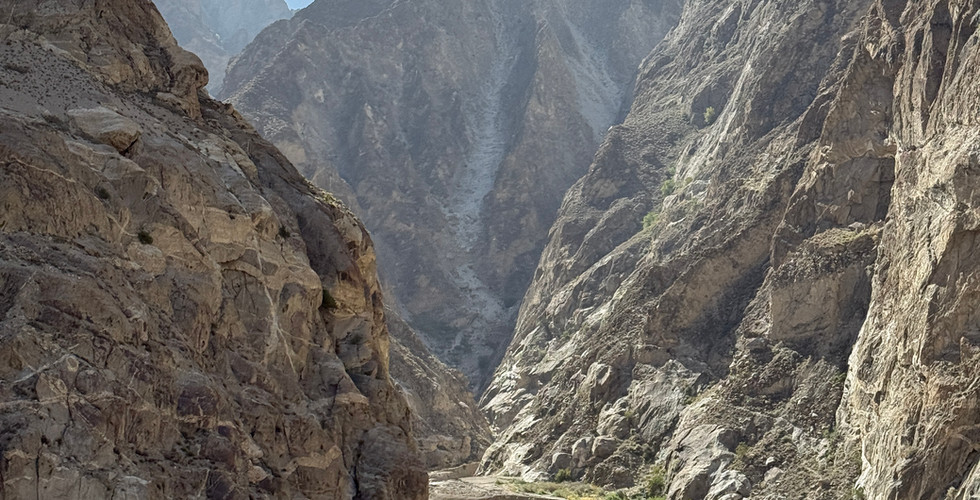
Roads are either broken or corrugated like a washboard.

The Pamir Highway is breathtaking - once part of the Silk Road, it still feels like the “roof of the world” - remote, exposed, and shaped by centuries of traders and travellers who passed this same way, long before diesel engines sputtered at altitude along its path.


The air cooled quickly. Life got easier; we could think again. Valleys opened, waterfalls cut across the road, rock faces closed in - brutal and beautiful at once. We felt our souls return.


Broken or corrugated roads in the mountains.


Life at Altitude


Back in the truck, reality struck: we hadn’t touched preventative maintenance in the heat, and the water filter was overdue for a clean. We have a simple candle-type filter that allegedly cleans all water of impurities apart from metals and makes any water fit for us to drink. That is, if you clean it regularly.


I opened it up to find the candle filter caked in brown sludge, and the housing was no better.

No wonder we’d been ill. If the sludge didn’t kill us, the smell might have. Another lesson learnt.


We climbed to 4,500 metres, and everything changed. I had a constant headache; Charlotte couldn’t lie down without gasping for breath.


Even our sealed plastic bottles of sauces and cleaning products, all expanded, one cleaning product blew its top and deposited the contents of some acidic fluid all over the worktops in the truck. Bought somewhere along the road and way too toxic to be sold in the Western world. It etched marks into our stone countertops, completely ruining them. Not the best of looks and a permanent reminder to take more care.


The truck suffered too. At that altitude, gas wouldn’t burn properly, so tea-making became a lengthy undertaking. Worse, the engine refused to start in the mornings. One night, we set alarms every three hours to fire it up, just to keep the diesel from solidifying.


At 4,500 metres, the truck took more convincing than I did to get moving.


Fresh food soon vanished and wasn't available to replenish, so pasta became our new best friend. After a week of improvising sauces, I reckon we’re Michelin-starred in pasta monotony.


Villages on the Edge


Filling the water tanks was a chore too; it meant pulling into villages where the only supply was hand-pumped water from a well. We watched a man ahead of us come from his home to draw two buckets of water for his family while our “swanky” overland truck sat behind him, leaving us feeling guilty at the contrast in our two worlds.


Cow dung was burned for heat because there was nothing else. Trees didn’t grow and survive at this altitude and with such harsh conditions. The local houses were made from bricks hand-formed out of mud and straw.


Life at 4,000+ metres was survival stripped bare.


Getting water is not easy when you can't turn on the tap.


At one roadside stop for diesel, I gestured clumsily to a husband-and-wife team holding their baby that we wanted diesel.


The wife first spoke Russian. I bellowed back that I only spoke English, and she replied, in perfect English: “How much diesel do you want?” We laughed, but when we chatted, obviously, the weather was on my mind, and the lady explained winters hit minus 50°C, the smile dropped. Their resilience dwarfed our struggles.


The diesel was initially pumped into a Jerry can from a large tank where they had stored the diesel.


They didn’t have electricity or a gauge to tell how much diesel we had, and so it was measured by the Jerry can, 20 litres at a time. That’s a lot of diesel when you want 300+ litres.


Filling with diesel, 20 litres at a time.


Parallel Worlds Along the Panj

Descending from the Pamirs, we drove for days along the Panj River. Afghanistan sat just across the water - so close we could see men in long gowns, women covered head to toe in 40°C heat, and children splashing in the river. The memory stuck. Parallel worlds, separated only by the river.


The Afghan side had calm domestic scenes; the Tajik side had army patrols, bunkers, and soldiers checking our papers.


One morning, at dawn, after we had camped by the river, looking into Afghanistan over the river, soldiers came to our truck, hammering on the door, demanding we open up. We got scared. What had we done wrong?


Their reason for the early morning visit, a warning for us, never to camp so close to the river again. They told us the Afghans were terrible people and that it wasn’t safe. They could come over the river in the darkness and do to us …….., the soldiers never did explain?


It felt the opposite - the families across the river looked more at peace than the soldiers who scowled at us from our own side.


We will never know the truth, I guess?


Looking over the river into the parallel world of Afghanistan.


Khaki Clad Tourists & Pushbike Heroes


The Pamir Highway is a magnet for travellers of all shapes and sizes. Cyclists pedalled past, barely acknowledging us, probably thinking we were mad for dragging a truck through their terrain, whilst we thought the same of them.


Convoys of westerners in 4x4s rattled by, dressed in safari khaki as if filming a wildlife documentary - though the only wildlife around was a few confused cows.

People do the strangest things.


We have had worse parkups.


A guard post on the Pemir highway.


We felt equally cynical about them as they likely felt about us. We are paddling our own canoe whilst others are driven at speed between luxury resorts and are fed on an array of western buffet food at night.

But the truth is, every traveller chooses their own hardship - be it pedals, aircon, or diesel alarms at 3 am.


Visitors are always welcome.


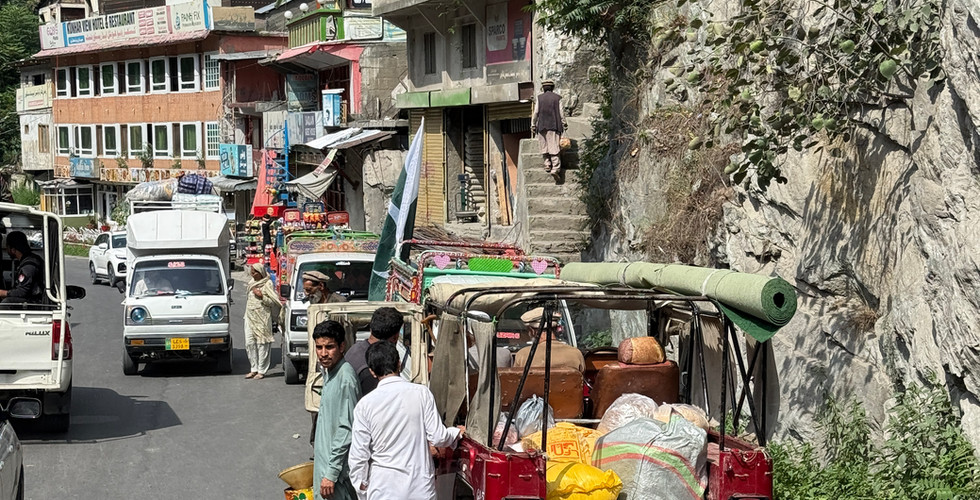
Villages and markets as we descended from the Pamir highway.


Perspective at Altitude

At 4,500 metres, everything expands - bottles, engines, tempers, even doubts about what we’re doing. But what expanded most was perspective. Watching villagers haul water, burning dung to stay warm, or children laughing in Afghanistan while soldiers scowled on our side of the river - it all pressed the same truth: the Pamirs test not just your truck or your lungs, but how you measure yourself against others who endure with far less.

Bring on the next challenge.


Thanks for reading, we hope you enjoyed it - if you haven't already, consider subscribing for updates on new blog releases.


....and if you want an insight into where we are and we we are doing in between blogs do check us out on Facebook.


“Adventure is just bad planning.” — Roald Amundsen


Checkpoint Roulette


Kazakhstan’s vast schlep lay behind us; Kyrgyzstan lay ahead, another line on the map, but a different rhythm entirely.


Crossing from Kazakhstan into Kyrgyzstan should have been routine by now. Another border, more paperwork, another search of the truck. But this crossing set the tone: chaos, separation, and the sharp reminder that overlanding never gives you all the answers.


I drove the truck through the usual checks - Guards reviewed the papers for the truck and motorbike, my passport, and searched for contraband. Charlotte was forced through another path, and we agreed to meet on the other side of the border checkpoint. She didn’t complain-she rarely does.


When I finally cleared no man’s land and entered Kyrgyzstan, there was no sign of Charlotte. I had Starlink, which provided me with internet, but Charlotte had no money, water, or food with her (a rookie mistake, which won’t happen again). I asked a guard if he’d seen her; it wasn’t a difficult question. Probably the only white, blonde to pass that day. He didn’t speak English and grew aggressive and telling me to leave. I’m not sure why?


It took twenty minutes of weaving through the chaotic mess of the border area to reunite. The scene was mayhem: So many people milling around, selling SIM cards, hawking food, shouting, meat grilling on skewers, and lorries barging through crowds of people doing what I have no idea. I was panicking. Where was she? Where was Charlotte? Those twenty minutes felt like twenty hours. Every scenario ran through my mind, none of them good. We found each other eventually, but the episode left me repeating the truth we’d muttered before: we don’t know everything.


Calm Fields, Closed Doors


Reunited, we drove out into Kyrgyzstan’s calm. Green pastures opened up before us, dotted with lakes. Simply stunning scenery.


In the countryside, farmers worked fields by hand while shepherds steered flocks of goats, sheep, and cattle with lazy dogs of no real assistance.  And in this region, the faces told their own story. Tall white Russians, squat Mongolians, Chinese-looking locals. Quite an array of different looks.


Since leaving the Middle East, we hadn’t seen Black, Caribbean, or African travellers at all - none. Stereotype or not, it was how the landscape of people struck me. Fascinating.

In the cities, the contrast was sharp: wide boulevards, modern layouts, a sense of order. People were laid-back, not rushing like in the West. Traffic was light, the streets clean. It was a pleasure to be there.


Bringing home animal fodder.

Yet beneath the calm, new problems surfaced for us. After the India–Pakistan spat, the Wagah border was closed, cutting off the only direct land route into India for us. A real issue is that we can no longer cross from Pakistan to India.


Our fallback meant heading into China, then Tibet and Nepal - but first, I had to secure a Chinese visa. Charlotte could enter with her Danish passport. I could not. Bishkek, Kyrgyzstan’s capital, gave us the bad news: no visas issued there. Options were thin. London was two flights away. The only real choice was a direct four-hour hop to Ulaanbaatar, Mongolia. Sunday-to-Sunday flights. So I left Charlotte with the truck and headed for Mongolia.


After the chaos of the border crossing, the decision felt heavier. Neither of us liked the idea of being separated again, but there wasn’t another option.


A Week in Ulaanbaatar


Ulaanbaatar was a collision of worlds. Sleek malls and international restaurants sat just beyond farmland where families lived in yurts. Winters hit -40°, and you could see it etched in faces hardened by survival. Traffic, though, was worse than anywhere I’d seen. My apartment host said her office was two miles away, but in winter, too cold to walk - two hours by car each way instead.


I hired a car and drove to see the colossal Chinggis Khaan equestrian statue - truly mega.

Even better was stumbling into the national archery championships. A thousand archers competing, all in traditional dress. Bows and arrows are handmade in the old style. The targets lay flat on the ground; when the arrows struck their target, a puff of dust rose to signify a hit. The crowd chanted in rhythm, rising in pitch with every release, cresting when arrows did indeed hit. It wasn’t a spectacle for tourists - it was heritage. Archery is one of Mongolia’s “Three Manly Skills,” alongside wrestling and horsemanship, and you could feel the weight of tradition.


Mongolia’s beauty was stark, but bureaucracy was harsher. At the Chinese visa office, I queued from dawn, only to be shoved aside, told my forms were wrong, sent back, and made to repeat the process. Hours stretched into eight. I was the only Westerner in the building. I felt like the idiot who hadn’t read the rulebook to a game everyone else had mastered. It felt less like paperwork and more like being tested. Eventually, the visa was in hand, and I counted down the days until I could return. After a week of Netflix, long walks, and sweltering heat, I boarded the flight back. A two-hour drive, a four-hour flight, and a three-hour haul later, I was back with Charlotte, visa ready.


Stamped, Sealed, and Squeezed Dry


From Kyrgyzstan, the road pointed towards Turkmenistan - a country you cannot enter without a guide and a prearranged letter of invitation. At the border, we met a group of Japanese tourists clinging together, pushing through like their lives depended on it. The officials charged us for everything they could imagine, each fee scribbled in triplicate receipt books and stamped to prove its authenticity. Wheels dunked in foul-smelling water for “sanitisation” - $30. Apparently, disease only travels by tyre tread. Who knew? Total cost: nearly $600, paid in a blur of meaningless slips.


Our guide suggested lunch. We asked for local food, nothing touristy. The restaurant he chose was packed with the same Japanese group we had encountered at the border. Not a promising start to our visit.


The desert roads afterwards were brutal: corrugated, broken, and slow. Twelve hours of jolting and we still had a hundred kilometres left to the first “attraction.” Our truck crawled at ten kilometres an hour while cars sped ahead. At that point, I pulled the plug. We’d camp in the desert instead. The guide panicked — tourists weren’t supposed to improvise - but we insisted. The night sky was worth it: zero light pollution, silence, and freedom. No Japanese. Just us.


The sights in Turkmenistan form a loop that you drive before exiting the country. A kind of theme park, but with huge drives between attractions. Great for tour buses and plenty of opportunities to stop and spend a little more money on cheap tourist souvenirs.

Turkmenistan’s tightly controlled system - receipt stamps, tour-bus routes, itineraries set in stone - wasn’t built for travellers who wanted to stray. We left and headed back into Uzbekistan.


Romance Meets Reality


Uzbekistan had the Silk Road romance we’d expected, but the heat and the roads were punishing. The truck’s air system failed from the constant vibration. The air pipe fittings gave up. I had spare fittings, but the wrong size. After five breakdowns, crawling under the truck in 40° heat beside a blazing diesel engine, I managed a bodge repair with tie wraps that seemed to hold just for a short time. Each time it blew apart, I slid under that furnace of an engine. Sweat didn’t drip - it hissed. Finally, It held.


Our fridge and freezer overheated, and inside our living box area, the temperature rose to 45°. In desperation, we switched off the fridge and freezer and fed stray dogs and cats with the thawing contents. Even then, it was unbearable. Hotels became our refuge.

Khiva should have been enchanting - Silk Road architecture, caravanserai echoes. Instead, it was crowded with souvenir stalls, pony rides, camel rides, carnival tat. Samarkand felt the same. The romance was buried under kitsch. I was turning off from the country.

By Tashkent, fatigue had us in its grip. The city itself was wealthy, modern, pulsing. The garage where we repaired the air system and prop shaft was a Mercedes dealership. The metro gleamed. But we were worn down, ill from the heat, buying antibiotics over the counter, unable to keep up with truck maintenance. Dust caked everything. The journey had shifted into attrition.


Roadside, eating out was practically a national sport, and we indulged, too weary to cook, and no fridge freezer meant fresh food was scarce. Shashlik everywhere, served with bread and onions, costing only a couple of pounds. Competition was fierce, and we sought out the best-looking spots. Plov was the national dish: rice, meat, carrots, onions, and garlic.

Vendors selling watermelons crowded every kilometer, as many as twenty at a stretch.

From Tashkent, we rolled on to the Tajikistan border. Another country, another turn in the road ahead.


Lessons in “Bad Planning”


No matter how many borders we’ve crossed, or how many repairs we’ve cobbled together under punishing heat, travel keeps finding ways to remind us of its contradictions. Unwanted separations, endless bureaucracy, and expectations that fall flat - the Silk Road wrapped in carnival tat, a breakdown instead of a vista. But just as often, the chaos brings something unexpected: archers chanting in unison, a desert sky blazing with stars, a moment of calm after the storm. Travel keeps reminding us we can’t plan for everything, nor should we.


Thanks for reading, we hope you enjoyed it - if you haven't already, consider subscribing for updates on new blog releases.


....and if you want an insight into where we are and we we are doing in between blogs do check us out on Facebook.


  • Aug 21, 2025
  • 1 min read

I wanted to write to say I am reworking the format of my Blog’s.

I hope to make them more informative and interesting as well as publishing more often.

This process is a few weeks away but then everything will hopefully be a lot smoother.


If you have any thoughts or ideas on what you would like to see more of, or less of of, please let me know.


Lastly, Thankyou for your continued support and please write to me if you have any thoughts, now or in the future.


David


© 2022 Sommertravelling

bottom of page