


Between Borders and Brothels: A Brief Drift Through Laos and Thailand
- Dec 12, 2025
- 6 min read
Updated: Jan 8
“To travel is to be constantly delayed by beauty and bureaucracy.” — Paul Theroux

Crossing the Line
After weeks of regimented travel through China, the border crossing into Laos felt like a release valve. The mood changed the moment the barrier lifted - from surveillance and order to a kind of messy freedom. The sense of relief was enormous: life eased, and we felt once again in control of our own destiny. No more convoys, no guides, no daily itineraries. Just us, the truck, and the road ahead!
We passed a group of young women being escorted back across the border line - deported, no appeals, no ceremony. We guessed they’d entered China illegally - why anyone would, we couldn’t fathom…but it was a quiet reminder that freedom isn’t equal for everyone. The contrast was sharp: the same gate that released us swallowed them.
It’s fair to say that leaving China came with relief, but also fatigue and a flicker of unease; what we’d escaped from suddenly looked more ordered than what we were entering.
The change you feel isn’t just political; it’s visible in the roads and faces. Painted signs turned to hand-lettered boards, trucks leaning under their loads, and the asphalt softening into red mud. Laos feels instantly different - slower, less sure of its rules, but open.

A street in Boten.- Quite unremarkable, but quiet at safe at last.
Boten Nights
The border town of Boten was a jarring kind of free. No cameras or checkpoints now - just lazy-looking stall holders plying their trade, and the low hum of diesel generators behind half-lit buildings. Freedom here had a different smell - one of beer, sweat and cigarette smoke.
Boten exists because of China, a Special Economic Zone meant for trade that slid into the shadow economy when the investment dried up. Empty buildings stand beside new ones plastered with Mandarin signs, a strange echo of the order we’d just left behind.
The place revealed itself to us in layers: brothels dressed up as karaoke bars, gambling halls humming through the night, Chinese men on “business trips” shepherded between vices by drivers in electric buggies. It was great to be free of China, but this version of freedom wasn’t something to celebrate.
Charlotte, very Danish in these moments, had no moral outrage about it - just curiosity. She commented on the girls’ make-up, how close they worked to each other, wondered what they ate, and how they lived. No judgment - just quiet observation. That’s her way.
We stayed a night before drifting on after lunch the next day, eating in the market. The food was refreshingly different, though we turned down the offer of live grubs – I prefer mine well done.

Live grubs are a delicacy in Laos. Sold in the markets and available on most menus.
Rain and Green
We didn’t drive far before pulling off into the rainforest. The air thickened into mist and frogsong. This was the rainy season, the kind that soaks through everything in minutes.
We parked under a canopy of dripping leaves, hidden from the road. Charlotte was quiet, glad to be alone and accepting of what nature was about to throw at us, knowing we were safe in our truck. The nets on the windows kept the bugs out, but the sound after dark was thunderous -No light pollution, no traffic, no human noise, just the rainforest breathing around us alive, unnerving, wonderful.
Despite the racket, it felt comforting. The truck has earned our trust through storms, breakdowns and borders - a giant comfort blanket of steel and diesel. Safe, warm and dry.
By morning the track outside was a river of slick red clay, tyres half-submerged. Laos’s roads are mostly narrow mountain routes; in rain they become skating rinks. Locals pass easily -battered trucks, scooters stacked with sacks - used to a life where wheels slide and patience wins.


Slow Roads, Warm People
A few hundred kilometres to Vientiane, the capital of Laos and the border town to Thailand, took days. Potholes, washouts and overloaded trucks crawling through bends. Laos doesn’t rush for anyone.
We stopped again in Vang Vieng, once a party town for backpackers. After too many accidents on zip-lines and overdoses on dodgy drugs, the place had quieted. A few travellers lingered, nursing beers where the party once raged. It felt like a town recovering from itself.
Evening markets lit up with smoky grills and plastic stools. Hmong vendors sold bright textiles beside bowls of noodle soup; rain hissed on tarps while the smell of charcoal and lemongrass hung in the air.
Roadside lunches came in big bowls of broth with noodles, vegetables and a hint of meat - tasty, though best avoided given the lack of refrigeration. About £1.50 a head, including the water you always needed to cool the spice.
The people were warm, but not too warm. They didn’t pry or ask where we were from. They had their lives, and we had ours. It was an easy coexistence - polite nods, no performance. After months of being stared at, the Lao way - reserved but kind - gave us the space we needed to decompress.


Our lunch stops were mainly bowls of tatstey broth and questionable meat?
Paperwork and Momentum
Paperwork soon caught up with us. The new Carnet de Passage for the truck and bike had been sent to Nepal, a destination now off the map after landslides closed the roads. For those who don’t know, a Carnet is the traveller’s passport for a vehicle - stamped at every crossing to prove you haven’t sold it abroad, backed by a hefty deposit back in the UK. A fellow traveller agreed to collect ours and carry them on to India for us. Just another example of the quiet kindness you meet on the road.
This win turned out to be short lived. Thailand threw a curveball: our import permit wasn’t valid until November. Another route change. Paperwork dictates destiny more than we like to admit - even freedom has its forms.

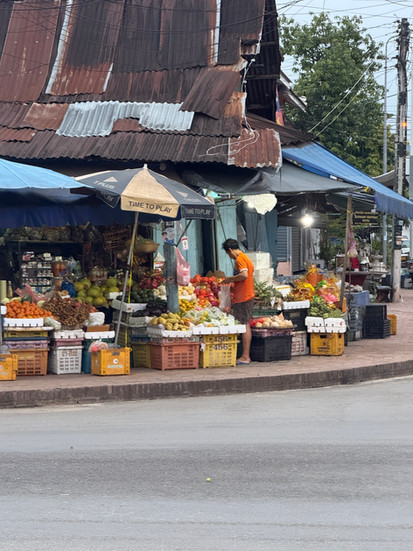

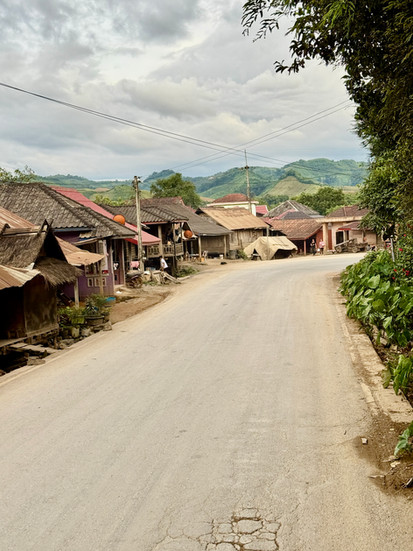





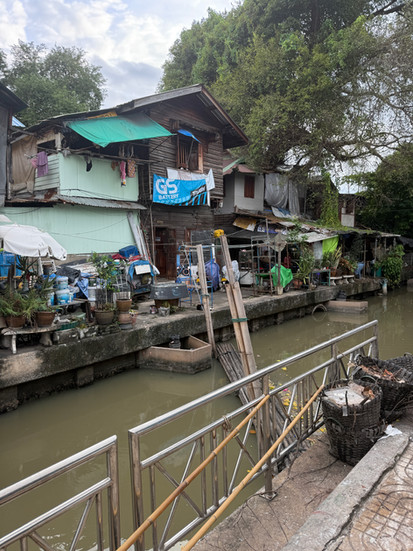


A few random images of Laos.
Bangkok: Then and Now
Vientiane was awash with Chinese tourists, flocking to every sacred site in town. We skipped the temples and booked flights to Bangkok instead - prices tripled overnight, naturally.
The city we knew from years ago has grown slick. The cheap hostels where we once arrived sweaty and broke are now “poshtels” - sterile, air-conditioned, curated. Travel has become a board game: signs, maps, reviews, no thinking required. There’s no stress when it goes wrong, so no elation when it goes right. Too much chill, not enough thrill.
That said, the chaos, the heat, the smell of street food - it’s all still there beneath the polish, and well worth a visit if you haven’t been, it’s just not as immediate and exciting as it used to be. Modern travel has smoothed out some edges that you need if you’re looking for adventure.
Laos and Bangkok, Thailand, had given us the respite we needed, but India was calling - our next stop the Ziro Music Festival, in the far eastern corner of the country. It would take two flights, a train and a three-hour taxi ride to get there. But that’s another story.
Thanks for reading, we hope you enjoyed it - if you haven't already, consider subscribing for updates on new blog releases.
....and if you want an insight into where we are and we we are doing in between blogs do check us out on Facebook.
In case you’ve not seen these…
How we got here (the previous blog)...
We were wondering which would expire first — us or our visa. Follow our 4,000-km gamble as landslides shut every easy way out...
Other popular posts
The road out of Ethiopia turned into a mud bath of bribes, breakdowns, and flooded crossings. One minute it was dust and diesel, the next it was gangs, collapsed bridges and a demand for 1.25 million in “cash.” By the time we reached the border, Africa had stopped feeling like a map and started feeling like a trap.
Tyres exploding at 120 kph, fuel bought from lads with AKs, and nights camped on dunes where no map dares show a road. Saudi was supposed to be a breeze — Iraq turned it into a shitstorm.
Crossing into Iran, we expected hostility. What we found was smuggled vodka, quiet kindness, and engines running on fumes. The contradictions ran deeper than any desert track — and we were right in the middle of them.