


Burning Brakes and Waiting Games - Peru, Part 1
Updated: Sep 8
“To travel hopefully is a better thing than to arrive.” - Robert Louis Stevenson, Virginibus Puerisque, “El Dorado”. (Project Gutenberg)
Story below...

Some faces tell a thousand stories
<<<Previous Next>>>
The lorry driver came past us flashing his lights and pointing towards our wheels.
I knew the brakes were getting hot. What I didn’t know was that they were actually on fire.
Luckily there was a lay-by just ahead, and I pulled in. By the time I got out, one set of brakes had properly caught light. I went for our fire extinguisher, but the lorry driver who had warned us had already stopped his truck, jumped out with his own extinguisher and put the flames out.
It all happened very quickly.
The moon scape hills between Bolivia and Chile.
Once it was over, Charlotte and I just stood there looking at each other.
The brakes had been on fire.
And I mean on fire.
Perhaps I should go back a day.
We had finally reached the Ollagüe border crossing out of Bolivia after a difficult couple of weeks. We had spent thirteen days being held up by road blockades, constantly waiting for somebody else to decide whether we could move. By the time we reached the Chilean border we were more than ready to leave all that behind us.
Naturally, the border was closed.
These are the hills that did for our brakes.
We arrived late afternoon at around 4,000 metres and had to spend the night there. The bigger worry was whether the truck would start the following morning. Altitude and cold are not a good combination for our truck and, after everything else Bolivia had thrown at us, being stuck at the border because the engine wouldn’t start would have been about right.
The following morning it was minus 7°C, so we waited until mid-morning for things to warm up a little before trying.
The engine turned slowly and we just managed to get her going on what must have been about the last of the battery’s energy.
Normally you turn the key and don’t think much about it. At 4,000 metres, with a cold diesel engine and a weakening battery, if it doesn’t start you simply aren’t going anywhere.
Customs was its normal pain, but eventually we cleared Bolivia and crossed into Chile.
Freedom again.
Or so we thought.
Google Maps then sent us onto an unpaved road. We assumed it was just a bad patch, so we lowered the tyre pressures and carried on. By the time we finally found tarmac again we had driven around 100 kilometres on dirt and were very pleased to see a proper road.
Then came the descent.
We had been travelling at around 4,000 metres, so sooner or later we had to lose all that height. In a big truck that brings its own problems.
Hard braking is not good, so I was using the gears as much as possible to hold us back, but there were sections where the brakes were unavoidable. I knew they were getting hot and had already started looking for somewhere to pull over and let them cool when the lorry driver came past us flashing his lights.
Then we discovered the fire.
There was a lot of flat areas, but a lot of hills as well.
The driver told us to let everything cool for about an hour and then move on. He also warned us that the area was known for theft because lorries regularly had to stop there with hot brakes, making them easy targets miles from anywhere.
That was comforting.
We stayed anyway. We were shocked and neither of us wanted to move the truck until we were happy everything had cooled properly.
It wasn’t the most peaceful night we have ever spent, but nobody robbed us.
The following morning I crawled around underneath and looked at the brakes. From what I could see, everything appeared okay.
It wasn’t.
We wouldn’t discover the full extent of the damage until later, when the brakes were stripped down in Arequipa. The pads were in pieces, some of the springs and rubber covers had been damaged and one 20-inch brake drum - a lump of metal I can only just pick up when it is in one piece - had broken into 32 pieces.
Quite how we had carried on I’m not sure.


Our favorite Peruvian meal. Ceviche - Raw Fish cooked in Lime juice.
Before getting underway we had a few truck jobs to do, including putting the last 80 litres of diesel we were carrying into the tank.
I held the fuel container while Charlotte held our funnel, although calling it a funnel is being generous. It was a two-litre water bottle we had cut up.
Diesel splashed over her hands. Her nails were already black from working around the truck and now her hands stank of fuel as well.
These were hands that had spent years tending to some of the best-tended heads in the world. Now they were holding half a plastic water bottle while I poured diesel through it.
How life changes.
Our journey through Chile was brief and we carried on towards Peru. Crossing that border gave us an odd sense of relief. There wasn’t any particular reason for it. I think instinctively we just felt we had finally left the latest set of problems behind and were heading north again, towards the eventual end of our journey.
We followed the Peruvian coast for a while because we wanted to stay away from altitude. The coastline was barren and, in places, filthy, and eventually we headed inland to Arequipa.
Arequipa was a pleasant surprise, an attractive old Spanish colonial city and surprisingly busy with Western tourists. We assumed many were heading to or from Machu Picchu.
The restaurants certainly seemed geared towards visitors. Guinea pig and llama appeared regularly as things tourists were apparently supposed to eat.
We had trout.
There are some beautiful buildings in various towns
Sightseeing, though, wasn’t the main reason we were in Arequipa.
The truck needed serious attention after the brake fire, and we also had American visa interviews booked at the US Embassy in Lima.
The appointments had been made months earlier and the blockades in Bolivia had already messed with our timetable, so rather than risk driving we left the truck with the garage and flew to Lima.
The visa interviews had been weighing on both of us.
We dug out the poshest clothes we owned, which weren’t very posh. I had a haircut and beard trim and we even checked our social media in case there was anything on there which might offend somebody, knowing full well there wasn’t.
Amazing what bureaucracy can do to you.
The interviews went well and our visas were approved, although they couldn’t be prepared before we had to leave Lima. That meant another trip back later to collect the passports.
One job done. Nearly.
A lot of ladies still wear traditional clothing
One strange thing we noticed in Lima was the Bee Gees. Their music seemed to be everywhere. After hearing them yet again, I Googled it to find out if we were imagining things.
We weren’t.
Back in the late 1970s, Lima’s Radio Inca started a programme called Quince Minutos con los Bee Gees - fifteen minutes devoted entirely to the Bee Gees. It became so popular that fifteen minutes became thirty, and eventually a full hour. For a time the station was playing so much Bee Gees music that they seem to have become part of Lima’s radio history.
Of all the things I expected to discover in Peru, a long-standing Lima love affair with the Bee Gees wasn’t one of them.
Back in Arequipa, the news about the truck wasn’t good.
Once the brakes were stripped down, the damage was far worse than we had imagined and some of the parts simply weren’t available locally. The truck was going nowhere for a while.
So neither were we, at least not in the way we normally travelled.
Rather than spend our days watching mechanics, Charlotte and I flew to Cusco.
It felt strange being without the truck. For all its faults - and there are plenty - it is our home. Our clothes, our food and pretty much everything we use while travelling are in it.
Suddenly we were carrying bags and using buses and taxis again. A bit like our backpacking days.
Cusco is the gateway to the Inca Trail and Machu Picchu, although we decided not to go there. Charlotte had visited about thirty years earlier and I wasn’t particularly interested in joining the masses at what, to me, looked increasingly like another tourist theme park.
I know plenty of people will disagree with me, and that’s fine.
There were other places around the Andes that interested us more. Walking through the old town rather confirmed my mood when, amongst all that Inca and colonial history, we found Paddy’s Irish Pub in a prime position. I did wonder what the Incas would have made of that.
Because we weren’t in the truck, we rented an apartment away from the main tourist area. It was basic, semi-clean and in a normal residential neighbourhood.
Cusco sits at around 3,400 metres and walking uphill quickly reminds you of it. Every now and then one of us would suddenly become short of breath. It only lasted a few seconds, but it could be quite disconcerting. We were also becoming semi-bored. That sounds ridiculous when you are sitting in the Andes in Peru, but it was true.
This time nobody was preventing us from going anywhere… we were just filling time because the truck had stopped for us, but the result felt strangely familiar.
We were stalled again.
Living away from the tourist centre also made us think about how fortunate Charlotte and I are. We travel the world in a huge truck with water, electricity, a proper bed and all sorts of creature comforts, and then get fed up because that truck is sitting in a garage.
Around us were people living very different lives. I don’t pretend to know what they thought about us, and I certainly don’t know why some of us end up with so much more than others.
Is there an answer? If there is, it’s beyond us.
We caught buses and travelled further into the Andes, spending much of our time just below 4,000 metres. We kind of got used to the altitude, although every so often that sudden breathlessness would return and remind us where we were.
Many of the older women we saw still wore traditional clothing: bowler hats, woollen leggings and raised skirts. It wasn’t being put on for us or for a photograph. It was simply what they wore.
Their faces were deeply weather-beaten from the conditions. Meanwhile, there was still no sign of the truck being ready. We flew back to Lima to collect our passports, now complete with American visas. That was something at least.
Then we went back to waiting so we walked a lot, slept a lot and tried to keep busy. Nobody could give us a reliable completion date. That also meant we couldn’t book accommodation for any sensible length of time, so we kept moving from one place to another.
Some of the brake components had to come from Belgium.
We ordered them using DHL’s five-day express service.
They took thirteen days.
Not very express.
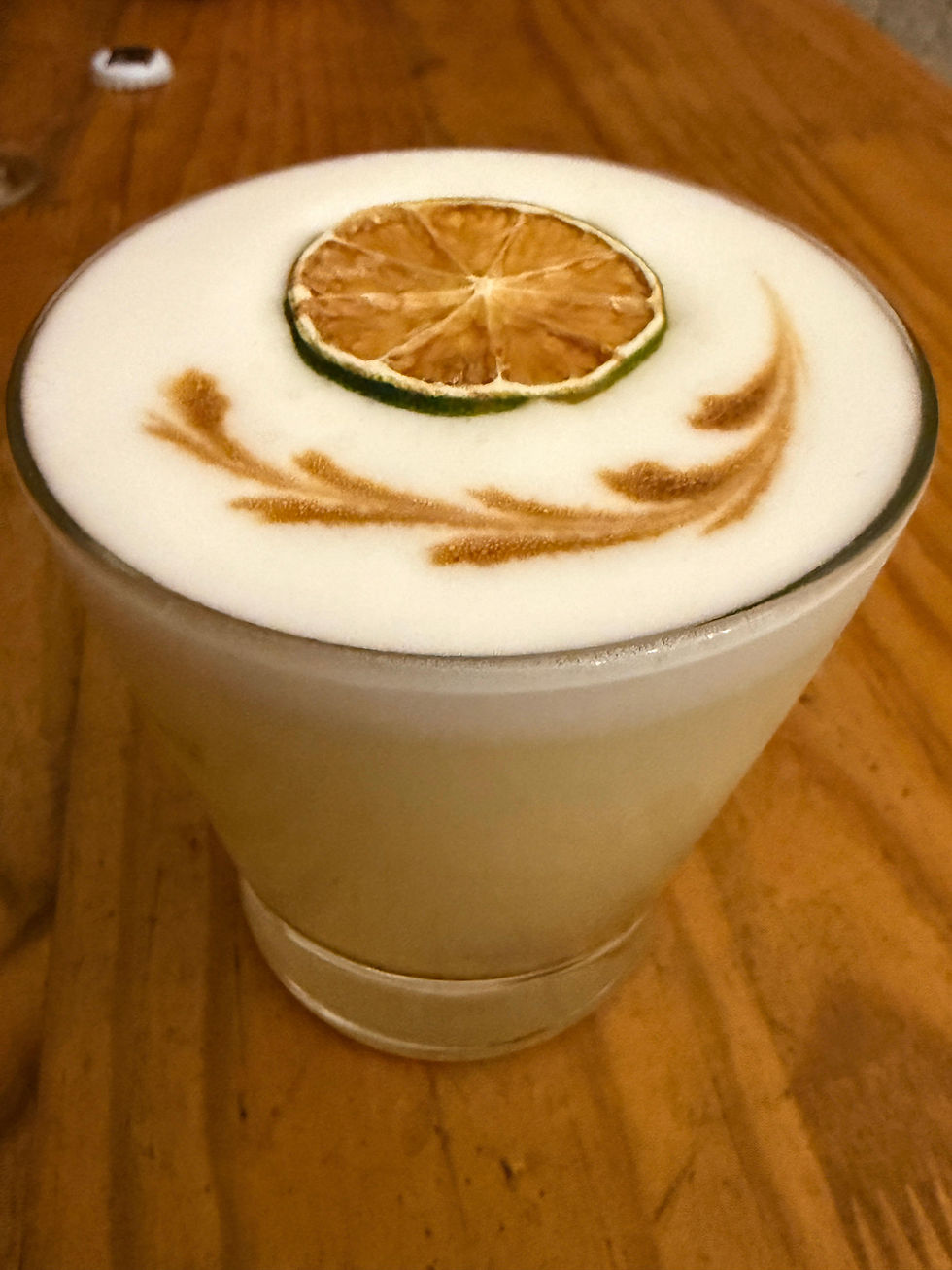
Charlotte was rather partial to a Piscoe sour or two. The Peruvian national drink based on the Piscoe liquor and Egg white. I muddled on with beer.
That delay pushed us into a week containing a two-day bank holiday, which made accommodation scarce as well. Then we fell for a scam.
We found what appeared to be a beautiful apartment at a reasonable price and jumped at it. When we arrived, the apartment simply wasn’t there. You couldn’t make it up.
Morale was getting low. Overlanding normally works because, however bad a place or situation becomes, eventually you move. There is another road, another town, another country. Movement changes things.
Instead, our lives were now being dictated by a garage, unavailable parts, DHL, visa appointments and whichever apartment happened to have a bed free.
After Bolivia, that began to feel depressingly familiar. There was still Peru to explore while we waited, so we headed for Lake Titicaca. I remember the name from my childhood, although I’m still not entirely sure why. Perhaps Titicaca is simply one of those place names a child never forgets.
We took a boat out to visit the floating islands made from reeds. The visit was interesting, although very tourist driven. At one point the rest of our group paid extra to go for a ride in a large two-storey boat shaped like a swan if you can imagine that? Disgusting!
We declined and stayed behind on the island…which turned out to be the most interesting part.
With the tourists gone, we watched some of the men laying fresh reeds onto the surface of the island to keep it maintained and afloat. It was ordinary work rather than something being demonstrated for visitors, and for a while we saw something that felt completely different from the organised tour. Then the swan boat came back, followed by other tourist boats doing slow laps of the island, presumably to make the fare feel worthwhile. With the tourists returning, makeshift tables appeared and out came the souvenirs.
Business as usual.
I understand people need to make money, and we were tourists ourselves, so we were part of the whole thing whether we liked it or not. Even so, I found the contrast disappointing. The bit that had interested us most was what happened while the organised experience had briefly stopped.
By the time we left Lake Titicaca we were into week three. The truck still wasn’t ready.
We had spent thirteen days trapped in Bolivia waiting for other people to allow us to move. Eventually we escaped, crossed into Chile and thought we had our freedom back.
Now, several weeks later, we were stuck again. Different reason. Same result.
Life goin’ nowhere, somebody help me...
So we needed another plan!
<<<Previous Next>>>
Thanks for reading, we hope you enjoyed it - if you haven't already, consider subscribing for updates on new blog releases.
....and if you want an insight into where we are and we we are doing in between blogs do check us out on Facebook.
Lost??
Catch up with our travels so far…
For the binge readers! Our new improved blogs start here...
Kazakhstan to Kyrgyzstan, on through Mongolia and Central Asia — chaotic borders, forced separations, visa dead ends, brutal heat, breakdowns, and the slow grind of overland reality trips the romance from the Silk Road
Other posts our readers loved...
A must read for those considering taken the road less travelled . Is this as scary as it gets? We certainly hope so!
Bribes, breakdowns, and flooded crossings. One minute it was dust and diesel, the next it was gangs, collapsed bridges and a demand for 1.25 million in “cash.”


Once again another fascinating read. I think you were very lucky that the brake fire was put out quickly as the consequences could have been catastrophic . I hope that the truck gets back on the road soon.
Wow you’ve both certainly had some trials and tribulation's! These are the times you’ll look back on and reflect on how mentally strong you’ve both been. Memories to last you a lifetime. I’m looking forward to the book too! I’ll bet you’re looking forward to spending quality time in Spain! Take care and hope the truck is soon sorted. xxx
So looking forward to the book. Get someone to check the spelling though eg beginners. xxx
I so enjoy bothering you on Facebook and now reading your blog. I will indulge myself and look back through some of your previous blogs and looking forward to your book. Safe travels.