


Brazil, not for begginers
Updated: Jul 28
“The real is not in leaving or arriving; it reveals itself in the middle of the crossing.”— João Guimarães Rosa
A Long Kilometre
Crossing into Brazil was like entering a new world.
It took us four hours to drive the last kilometre to the border, and apparently, that’s normal. I’m not sure who decides what normal is at South American borders, but they have a very different idea of it than I do.
We had come in from Paraguay, which, to be honest, hadn’t exactly detained us. I had bought a small independent guidebook before we set off, and it basically didn’t have anything in it. In Asunción, the old town was described as probably the highlight of Paraguay. In reality, it was one scruffy street with a few semi-interesting old buildings. But they were just scruffy, which took away any charm.
We had one beer in a bar. We had planned on having dinner out, but the place was huge, heavily lit and had zero atmosphere, so we drank up, went back to the truck and made ourselves an omelette.

The capital of Paruguay - Charlottes on the photo, believe it or not
Brazil immediately felt different. Orderly-ish streets, proper signposts and a feeling of more money about the place. The only downside was the constant and enlarged speed bumps everywhere. Brazil does not do subtle speed bumps. It builds small defensive structures across the road and lets your suspension find out for itself.
Waterfalls and Sweetcorn
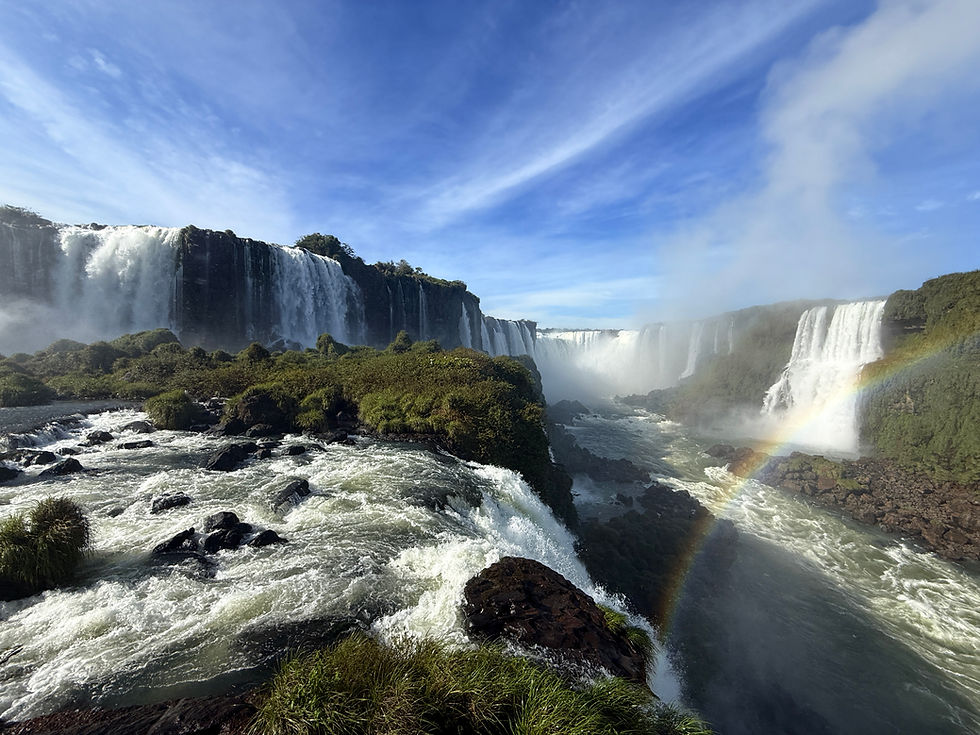
Our first proper stop was Foz do Iguaçu water falls.
Both Charlotte and I had visited the falls almost 30 years ago, but not together. Funny, I don’t remember seeing her there?
The falls are so big they can be viewed from Argentina or Brazil, with Paraguay just down the road as well. They sit in a corner where 3 borders meet.
They now have an impressive visitor centre, souvenir shops and buses to take you to a nature trail and various vantage points. A far cry from the dirt road I remember, but still spectacular.
The noise is the thing. You can see photographs of Iguaçu and understand that it is big, but you don’t get the weight of it until you hear it. It is less like water falling and more like the planet emptying a reservoir over the edge of itself.
Prepare to get wet.
I have mentioned before, but I can’t state enough how vast South America is. We left the falls and drove country roads for three days, seeing little else other than sweetcorn plantations. They were on both sides of the road and went back as far as we could see.
Truly amazing.
How much sweetcorn do we eat?
Stopping for the night was easy. There were loads of farm tracks where we could pull off the main road and hide. No drama, no campsite, no reception desk. Just a track, a field and the usual calculation of whether anyone was likely to appear with a torch and ask what we were doing there. Nobody did.
That counts as a successful night.

Paraty and Portuguese
Our destination was Paraty, a beautiful town with whitewashed buildings, cobbled streets and a beach nearby, which is always handy.
We went into town on a Sunday. It had the usual range of coffee shops and souvenir shops, but the street vendors were more interesting to us. They were selling trinkets and appeared to be Indigenous people, quite different in appearance to the people working in the shops and cafés. We had grown to love the South Americans speaking Spanish. Not because we were any good at it, but because we had reached the point where we could just about get by, which is different from being competent but feels like a major achievement when you are hungry, tired or trying to buy diesel.
Now we were in Brazil, where they speak Portuguese. There are some words in common with Spanish, but that made it worse. I had to stop myself trying to read signs, because it was confusing my already very limited Spanish.
Paratay. Very pretty and well worth a stop.
Rio in the Dark
From Paraty, we slogged on to Rio de Janeiro.
As we drove in through the suburbs, we realised it was time to get the pepper spray out from its hiding place. We arrived late, which was not clever. Driving the streets of Rio in the dark is not a hobby I would recommend. Charlotte was navigating, I was gripping the wheel, and neither of us was exactly full of joy. There was filth, fires burning at the side of the road, beggars scavenging through piles of rubbish looking for something of value, cars that were decidedly beaten up, gangs of youths hanging on street corners, and a woman flagging down a bus with her child on her breast, for all to see.
As we squeezed into town, the roads narrowed and the traffic got heavier. Then a bus took my wing mirror. I initially gave chase, then realised that even if I could stop the bus, how exactly was I going to explain what had happened? And did I really fancy getting out of the cab as it was coming on dusk in Rio de Janeiro?
Nope.

One of the common sites in some areas of Brazil.
At the time, we didn’t know if the mirror was damaged or just displaced. Charlotte couldn’t pull it back into place, and driving became even more of an issue. You use your mirrors a lot more when driving a large vehicle, so not having both of them in a city was not ideal.
What had actually happened was it had been pushed out of place and just needed untightening and putting back.
But again, on a lorry, that means standing on a stepladder to reach it.
Nothing is easy.
Our destination was a secure parking area behind huge steel doors. Not pretty, but safe, and ideal for visiting the city during the day. At that point, pretty was not high on the list.
Beaches and Buckets
We did the usual Copacabana and Ipanema beaches.
The large police presence made us feel safer, though I’m not sure whether needing a large police presence should ever be considered reassuring. The beaches felt a bit sleazy to me, with the usual array of tourist tack on the streets and discounted drinking shacks along the beach edge.
There was plenty of flesh on display, even though the weather wasn’t great.
Some of it was braver than the weather deserved.
We ventured a few streets back from the beach, but soon realised this wasn’t wise. The mood changed quickly, the shops looked run down and the street felt less forgiving. We turned around and went back to the seafront.

Copacabana beach
One observation: there are loads of VW camper vans in Brazil. They seem to be used for everything, but mainly for transporting goods. Not the polished Instagram version with fairy lights and a surfboard on top. Proper working vans. Dented, useful and still going.
The statue of Christ the Redeemer was on my bucket list. I had failed to get up to it on my last visit, so I was determined this time.
As we loitered around the visitor area, we were approached by an unofficial guide offering his services. We were unsure of his credentials, and he didn’t really match up somehow, so we decided to test his knowledge before agreeing to use him.
We asked him when the statue was built.
He looked a little perplexed, stared at the floor and eventually said, “Well, it was before I was born.”
We estimated our potential guide was actually a Rio street kid, aged about nine years old.
We didn’t engage his services, but gave him a tip anyway.
You had to admire the effort.
In the end, we didn’t make it up to Christ the Redeemer. The weather was bad, and we didn’t want to be on top of a mountain when the rains came.
And they did.
So Christ the Redeemer remains on the bucket list.
Again.

Cocacabana.
The Favela We Didn’t Find
We also wanted to go back and do a favela tour. Favelas are the slum areas, and we were told they are mainly self-policing and therefore safe, or at least safe in their own way. The police don’t normally go near some of them, and the residents are left to manage their own security, although “manage” can mean different things depending on who is holding the gun.

The Favela are grim looking places.
We had both done a favela tour on previous visits, but they now appeared to be extremely tourist-driven, so we decided we would go alone. Unfortunately, or fortunately, we got lost.
Charlotte was navigating our walk, and we missed the first favela as she misread the map. It wasn’t mentioned by me or her, as I didn’t want to cause a scene. Marriage, like overlanding, sometimes works best when you shut up and keep moving. As it was getting dark, we abandoned our efforts and retreated to the truck.
The next day, we reluctantly contacted a guide and asked if he would take us to the favela we wanted to visit, Chapéu Mangueira in the Leme area of Rio.
His response was no.
There had been a shooting there yesterday, and it was closed. We decided it might be better to take a tour and it was fascinating. We were told the drug barons rule the favelas. They are the judge and jury in disputes, and rapists and paedophiles are simply killed. Their bodies disappear, and the police are not allowed in, so nobody officially knows anything.
The people live almost on top of each other, and they respect each other, or have to. Our guide said the strict local rules keep everyone in check. The buildings were ramshackle but rose up to five stories high, no higher. Many of the inhabitants, he said, were construction workers, and the area was safe because people respected each other and understood how the place worked.
I’m not so sure.
Bread Queue, Drug Queue
Brazil’s history sits heavily underneath all of this.
I had in my notes that more than half the population identify as Black or brown, descendants in part of Africans brought across through the Portuguese slave trade, which brought millions of enslaved people to Brazil. Brazil also still has the largest Catholic community in the world, though religion there, like everything else, is shifting.
There is wealth in Brazil, plenty of it, but there is poverty on a scale that is hard to ignore once you leave the postcard streets. 40% of the population (213,000,000 is the population) live on €250 a month. Recent figures put around 23% of Brazilians below the poverty line, with millions still living in extreme poverty and Rio makes sure you see both.
A shop and various other buildings in the Favela
Food smells that were amazing, but often followed by the occasional waft of shit. I’ve had that smell on numerous occasions now, and I’m getting tired of it. The whole area was unkempt and filthy, but also alive in a way the polished beach streets were not.
Brazil is complicated like that. It gives you beauty and then makes you step over something.
But it is a party town, and so there was music everywhere.
As were drugs.
In the Favela, we went to see a project to teach streets kids dance and music.
Brazil is a major domestic market and a strategic transit hub for cocaine because of its borders, ports, airports and links to Andean producer countries. And drugs are not hidden away in some dark corner. They are woven into the place. On one occasion we saw what appeared to be a drug stall, and the queue was almost funny. People were lining up like they were buying a packet of bread.
Taxi drivers, guides and any friendly soul who bothered to speak with us all said the same thing: be careful and don’t have your phone on display. To be fair, I’d be careful with my phone in London, so maybe it’s just the same, only with better scenery and worse driving. I wear a plastic watch, but Charlotte has a reasonable one, about £300, and she took it off and left it in the truck.

Into the Pantanal
Leaving Rio, we headed towards the Pantanal.
The Pantanal is vast, somewhere between 150,000 and 190,000 square kilometres, depending on where people draw the edges. Roughly two-thirds the size of the UK, which is a ridiculous amount of swamp by anyone’s standards.
Our aim was a boat trip to see wildlife, and maybe even spot a jaguar.
Having looked for tours, we found the usual selection of tourist crap. A traditional Brazilian breakfast, followed by a walk, then a boat trip with others, probably all wearing clean shirts and looking pleased with themselves.
We wanted something more authentic.
After asking around, we got the phone number for a farmer who had a boat. He agreed we could stay on his land, and he would take us out.
We arrived at a remote farm late in the afternoon and quickly arranged that we would set off for the boat trip at 06.00 hrs.
That was that. He wished us goodnight.
I wasnt so sure about several of the bridges. At 12.5 tonnes, we have to be careful.
The next morning, he appeared bright and early with a gun in a holder on his waist.
I asked what it was, meaning was it real.
He casually said, “Glock 9mm.”
I asked why he wore it. He said it was for protection against the jaguars, as they sometimes came through his farm. I didn’t dare tell him I had been barbecuing the night before and had grilled two steaks. Lucky escape. I could have been dinner.
No Jaguar, Plenty of Insects
The Pantanal visit was roaring and real.
It was the dry season, which should have meant the animals gathered near the river as the swamps dried out. Except Brazil had other ideas. There had been unusually heavy rain, the rivers were swollen, the swamps were full of water, and the jaguars clearly had better things to do than entertain us.
The mosquitoes early in the morning were horrendous, and as the sun came out, so did the flies. They were like horseflies, and we used long linen scarves to protect ourselves.
Very stylish. Very Lawrence of Arabia, if Lawrence of Arabia had been sweating in a swamp and quietly losing the will to live.

It was 30+ degrees and I had to wear long sleeves and trousers to protect from the insects.
We didn’t see a jaguar, but we saw plenty of caiman, birds of all flavours, and had a great trip alone on a boat with an interesting farmer.
We had avoided the packaged tour, found a man through a phone number, slept on his land, gone out at first light and been eaten alive by insects.
That will do for me.
He was an understated guy, and I asked him what he farmed.
Cows.
He told me he had 2,000 of them.
I Googled the cost of a cow in Brazil.
It’s a big number.
Are you going to Google it?

The Middle of the Crossing
We came looking for waterfalls, Rio, Christ the Redeemer and jaguars. We got some of that. We also got a broken mirror, bad weather, a closed favela, swollen rivers, insects, warning looks from strangers and a farmer carrying a Glock.
What can I say? Brazil is not for beginners. But then, beginners probably shouldn’t be driving trucks through Rio in the dark anyway.

A murial near a church depiciting the last super. God is Black
Thanks for reading, we hope you enjoyed it - if you haven't already, consider subscribing for updates on new blog releases.
....and if you want an insight into where we are and we we are doing in between blogs do check us out on Facebook.
Lost??
Catch up with our travels so far…
For the binge readers! Our new improved blogs start here...
Kazakhstan to Kyrgyzstan, on through Mongolia and Central Asia — chaotic borders, forced separations, visa dead ends, brutal heat, breakdowns, and the slow grind of overland reality trips the romance from the Silk Road
Other posts our readers loved...
A must read for those considering taken the road less travelled . Is this as scary as it gets? We certainly hope so!
Bribes, breakdowns, and flooded crossings. One minute it was dust and diesel, the next it was gangs, collapsed bridges and a demand for 1.25 million in “cash.”


Absolutely fascinating, great reading and photos .
Fabulous travel blog. Thanks. Makes our holiday adventures look far too sanitised. You are fearless adventurers. I hope someone finances a book deal or even a movie. Keep safe but keep connected.
Wow, more amazing life experiences, I think I can manage without a lot of those too tho’ . Enjoy and stay safe xx
Great reading ! I love reading your adventures. We have visited South America, we would recommend it.
We loved the Iguacu Falls unbelievable experience . Rio is fun and you meet some great people.
Looking forward to the next instalment.
Thank you so much for detailing your experiences in Brazil. Always had a hankering to go but after reading I think I’ll take a rain check. I value my existence too much to take the risk!
Keep on trucking; your travelogues are always fascinating!